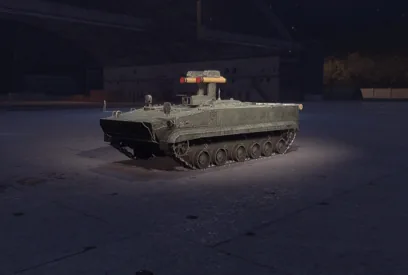
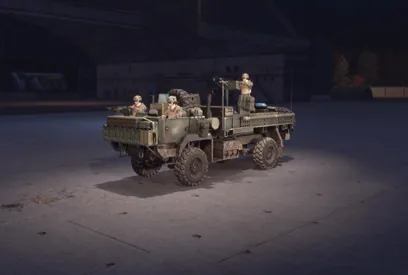
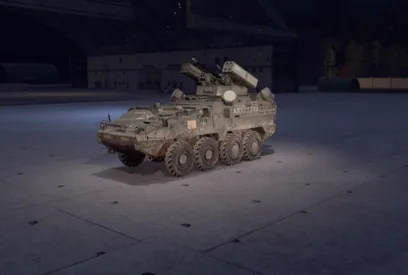
 160pts
 Stryker M-SHORAD
Stryker Cavalry regiment
60kin front
100best pen
100km/hspeed
Checked on build 26052592
A guided missile in Broken Arrow falls for a moment after launch, burns its motor to speed up, then coasts and slows until it is destroyed at 30% of its top speed. From the game's code It can die sooner, for example if it loses its target or its shooter stops supporting it. From the game's code Whether it hits is decided by a roll, not by the chase. From the game's code
A missile's flight follows four stages: From the game's code
MainEngineIgnitionDelay).Acceleration each second, up to its top speed (MaxSpeed), for BurnTime seconds.LostEnergy.A missile that reached its top speed therefore coasts for about 5.4 s before it is destroyed. Worked out by this site
The plane-launched AMRAAM shows the numbers. The first four come from its row in the data: From the game's data
| Stage | AMRAAM |
|---|---|
| Ignition delay | 0.5 s |
| Acceleration | 200 a second |
| Burn time | 4 s |
| Top speed | 1150 |
| Slow-down after burnout | 149.5 a second |
| Destroyed at | 345 |
The last two follow from the top speed: 13% of it and 30% of it. Worked out by this site
Launch speed matters. An AMRAAM that leaves the rail at 350 or more, in the data's speed units, reaches 1150 by burnout and then coasts 5.4 s. One that left at rest would reach only 800 by burnout and be destroyed about 3 s later, some 7.5 s after launch. Worked out by this site
A missile starts at the shooter's speed times the cosine of the angle between weapon and shooter, plus the round's own MuzzleVelocity. From the game's code So a missile fired straight ahead keeps all of the shooter's speed, and one fired at an angle keeps less. Worked out by this site
Most ground anti-air rounds have a MuzzleVelocity of 0 to 100, so a ground missile starts near rest, but not at rest. From the game's data The duel times a missile's flight from a standing launcher. Worked out by this site
Only by staying out of its reach until it slows to the 30% cutoff. From the game's code A missile still on course keeps steering while it coasts, and the roll decides the hit, not the motor. From the game's code So unless the missile dies first, the outcome is settled by its rolls: the first when it registers its target, and a re-roll each time the target's count of burning decoys rises before impact. Worked out by this site
Running can still help. A missile gets only the decoy re-rolls that come before its impact, so a longer chase gives your decoys more chances to make it roll again. Worked out by this site On a plane, only the first three decoys are certain to cause a re-roll. From the game's code How that works is in missile hit chance.
The seeker type says how a missile is guided. The names are the game's: From the game's data
| Type | Seeker |
|---|---|
| 10 | Fire-and-forget (infrared) |
| 50 | Terminal guidance |
| 100 | Semi-active |
| 200 | Anti-radar |
| 300 | Laser |
A round with seeker 0 has no seeker: it is unguided. In the data, every round with a seeker flies the guided trajectory and no round without one does. From the game's data In the current data, 74 rounds are semi-active, 27 terminal guidance, 25 fire-and-forget and 6 anti-radar, and 508 have seeker 0. No round uses type 300. From the game's data
Terminal guidance and semi-active seekers need the shooter to keep guiding the missile. From the game's code That ties them to the shooter twice: its stress lowers their hit chance, and they die if it stops supporting them. From the game's code
The game destroys a missile before its motor runs down for any of these reasons: From the game's code
| Reason | When |
|---|---|
| It loses its target and cannot lock on again | Only when its CanReaquire is false. From the game's code Every fire-and-forget anti-air missile has false, so for them losing the target is fatal. From the game's data |
| Its shooter stops supporting it | Only seekers that need the shooter: terminal guidance and semi-active. From the game's code The exact conditions have not been traced. Not known: our best reading |
| Its shooter's new target is outside its seeker | The shooter switches to a target outside the missile's own seeker cone. From the game's code |
| Too long without a target | More than 2 s, or no time at all for a terminal-guidance missile. From the game's code |
In player terms: a terminal-guidance or semi-active missile lives only while its launcher supports it, and a launcher that switches to a target outside the missile's cone kills its own missile. From the game's code
A missile's flare resistance enters its hit roll once for every burning decoy. From the game's code Every guided round has 0, except two with 1.0: the Hydra Fletcher, an anti-air APKWS rocket, and the Khrizantema thermobaric missile. From the game's data These units carry them:
As the formula is written, resistance 1.0 makes the hit chance 0 whenever a decoy burns. From the game's code That looks backwards for a field with this name, and what happens in play is not known. Not known: our best reading
The game's data gives each missile a row of columns. Here are the plane-launched AMRAAM's, in player terms. A "code" mark means the game's code was read using the column; a "data" mark means its meaning comes from the column's name.
| Column | AMRAAM | In plain terms | Source |
|---|---|---|---|
TargetType | 16 | What it may engage, as a sum of flags. 16 is aircraft only. See target types. | From the game's data |
Seeker | 50 | Terminal guidance. | From the game's data |
TrajectoryType | 110 | Its flight path: 110 leads the target, and every anti-air missile uses it. | From the game's data |
DispersionHorizontalRadius | 1.0 | For a missile, its accuracy: 100%. | From the game's code |
DispersionVerticalRadius | 0 | For a missile, its flare resistance. | From the game's code |
MainEngineIgnitionDelay | 0.5 | Seconds it falls before the motor lights. | From the game's code |
Acceleration | 200 | Speed gained each second while the motor burns. | From the game's code |
MaxSpeed | 1150 | Top speed. It also sets the slow-down after burnout (149.5 a second) and the speed at which it is destroyed (345). | From the game's code |
BurnTime | 4 | Seconds the motor burns. | From the game's code |
RotationSpeed | 90 | How fast it turns. The code reads it; "degrees per second" is our reading of the name. | From the game's code Not known: our best reading |
PreEgnitionRotationSpeed | 0 | How fast it turns before the motor lights. | From the game's code |
AimStartDelay | 0.5 | Delay before it starts steering. | From the game's data |
SeekerAngle / MaxSeekerDistance | 140 / 700 | Its own seeker's cone and reach. The reach's unit is not stated; if it is data metres like the ranges, it is 1400 m on the game's doubled scale. | From the game's data Not known: our best reading |
CanReaquire | true | Whether it can lock on again after losing its target. What false does is read in the code (above). | From the game's data From the game's code |
LaunchMarginAngle | 45 | How far off the nose a target may be at launch. | From the game's data |
LoftAngle / LoftHeight | 5 / 100 | Its climb after launch. The height's unit is not stated. | From the game's data |
MinimalRange / LowAltRange / HighAltRange | 500 / 3500 / 3500 | Closest and farthest reach, in data metres. As the game shows them: 1000 m, 7000 m and 7000 m. | From the game's data From the game's code |
RadioFuseDistance | 12 | Proximity fuse distance: 12 data metres, or 24 m as the game shows distances. | From the game's data |
HealthAOERadius / StressAOERadius | 15 / 15 | Blast radius for damage and for suppression: 15 data metres, or 30 m as the game shows distances. | From the game's data |
CanBeIntercepted / CanBeTargeted | false / false | Whether active protection or anti-air can stop it. | From the game's data |
Active protection stops only rounds marked CanBeIntercepted. From the game's code
RotationSpeed; that it is in degrees per second comes from its name only. Not known: our best reading